
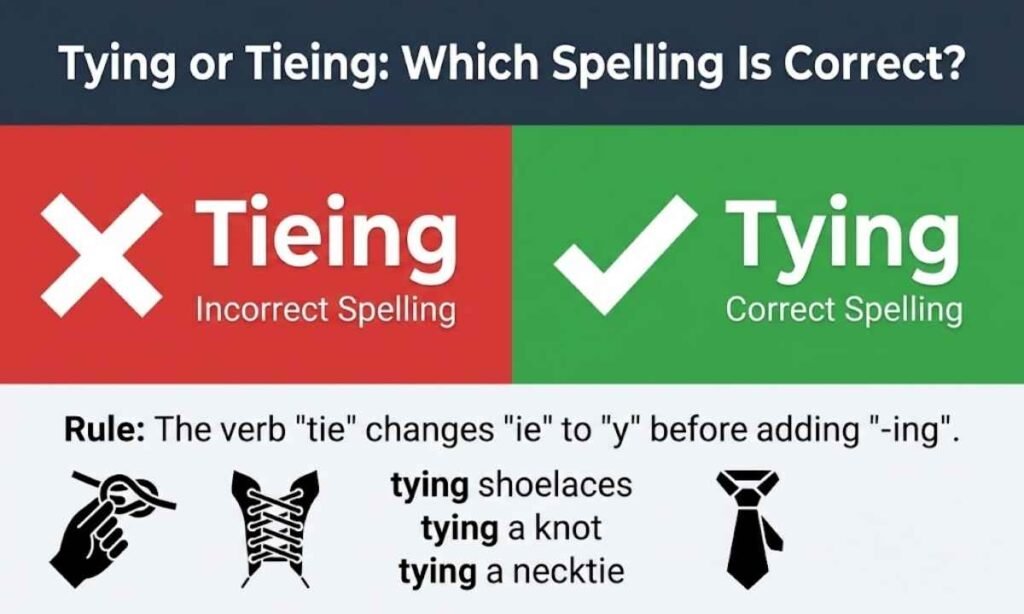
Few small spelling choices cause as much second guessing as tying or tieing. Both look natural, and writers often type the second one because it seems to follow the base word tie. A quick look at a dictionary settles it, and the answer is simpler than most people expect.
Tying is the correct spelling. This guide explains the rule behind it, shows real examples from daily life and work, and compares it with lying and dying. You will also get a memory trick, a short checklist, and clear answers to common questions. It is written for students, professionals, and busy writers.
Tying vs. Tieing: Quick Answer
• Tying is correct.
• Tieing is a misspelling in standard English.
• The rule: change the ie in tie to y, then add ing.
Is It Tying or Tieing?
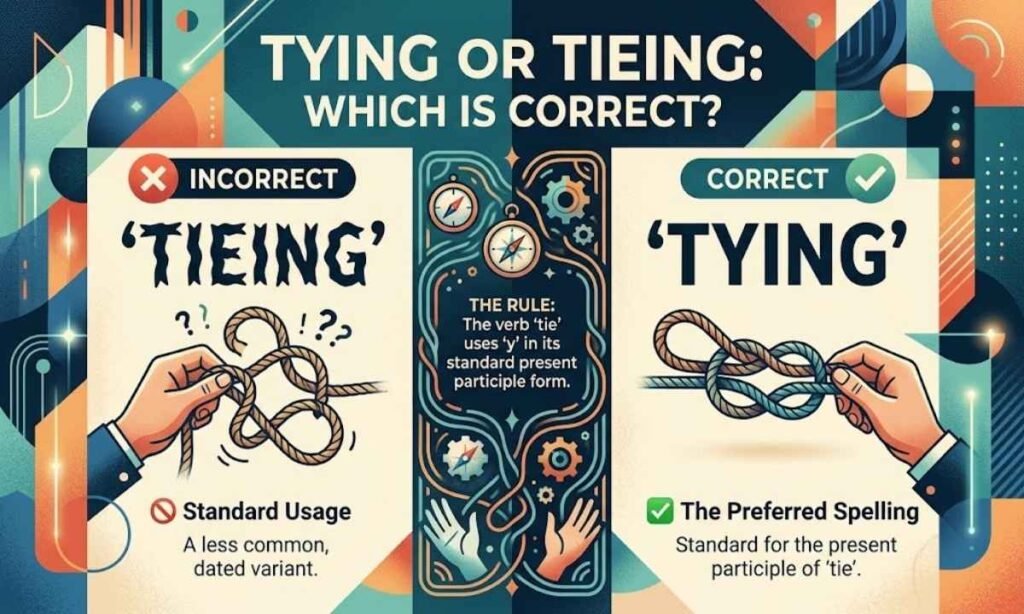
The Correct Spelling in American English
Tying is the standard spelling in American English, and British English uses it too. Tieing is not accepted in standard writing, even though a few dictionaries list it as a rare variant.
Tying vs. Tieing at a Glance
| Spelling | Status | Example |
| Tying | Correct | She is tying her shoes. |
| Tieing | Incorrect in standard use | She is tieing her shoes. |
Why Is Tying the Correct Spelling?
The Spelling Rule for Words Ending in ie
When a verb ends in ie, English changes the ie to y before adding ing. Keeping the ie would stack vowels in an awkward way, so the spelling shifts. This rule is old, steady, and used across the language.
Why Tie Changes to Tying Instead of Tieing
The same pattern turns tie into tying, lie into lying, and die into dying. Tieing breaks that pattern, which is why it looks wrong to trained readers and to spell checkers alike.
Think of it as a small repair. The letters ie would sit awkwardly beside the i in ing, so English swaps them for a y. The sound stays the same, and the word becomes easier to read. Other verbs that end in ie, such as vie, follow this path too, giving vying.
What Does Tying Mean?
Tying as a Verb Form
Tying is the present participle of tie. It shows an action in progress, as in “He is tying a knot” or “She was tying a ribbon.”
Tying as a Gerund
It can also work as a noun. In “Tying a tie takes practice,” the word names the activity itself, so it acts as a gerund. Grammar texts treat this use as just as common as the verb use, and the spelling stays the same.
Literal and Figurative Meanings of Tying
• Literal: fastening with string, rope, cord, or laces.
• Figurative: linking ideas, as in “tying the story together.”
• Competition: ending a game with equal scores, as in “tying the match.”
Tying or Tieing: Examples in Sentences
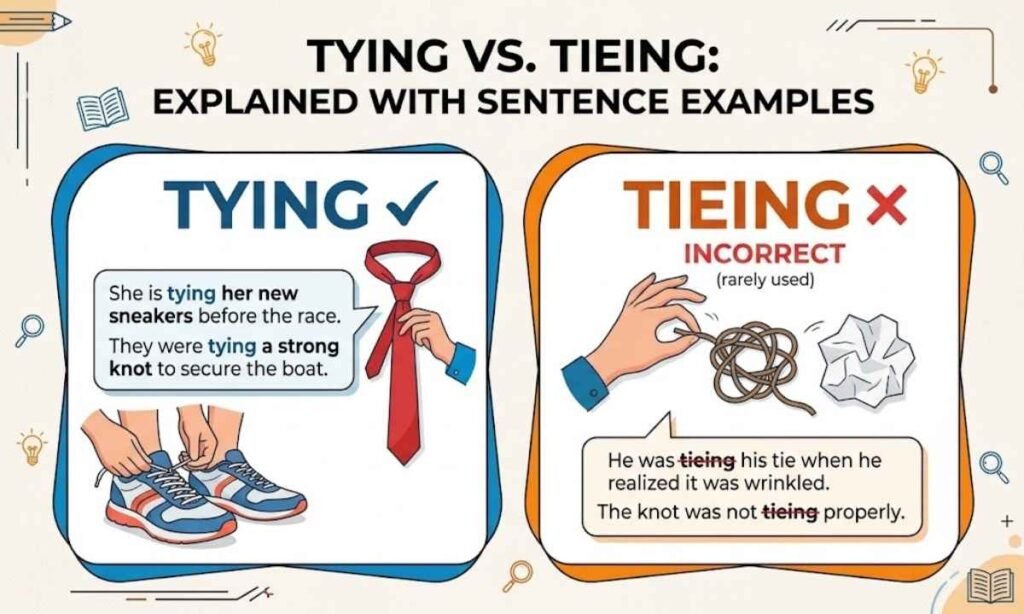
Examples of Tying in Everyday English
• She is tying her hair back before the run.
• He spent the morning tying fishing lines.
• They are tying balloons to the fence.
• The sailor is tying the boat to the dock.
• My brother is tying his tie for the interview.
Examples of Tying in School and Workplace Writing
• The essay succeeds by tying every example to the thesis.
• Our team is tying the new budget to quarterly goals.
Correct and Incorrect Tying Sentences
• Correct: I am tying my shoes.
• Incorrect: I am tieing my shoes.
• Correct: The goal is tying the match at two.
• Incorrect: The goal is tieing the match at two.
Is Tieing Ever Correct?
Why You Should Avoid Tieing in Modern Writing
Style guides and teachers mark tieing as an error. Using it in a resume, essay, or article can make the writing look careless, even when the rest of the text is strong.
A few older or specialized sources show tieing as an alternate form. Those cases are rare, and modern editors still prefer tying. If you want your work to pass a careful edit, choose the standard spelling every time.
How to Correct the Spelling Mistake
Search your draft for tieing and replace every instance with tying. A quick find and replace takes seconds and removes the error for good.
Tying vs. Tied vs. Tie: What Is the Difference?
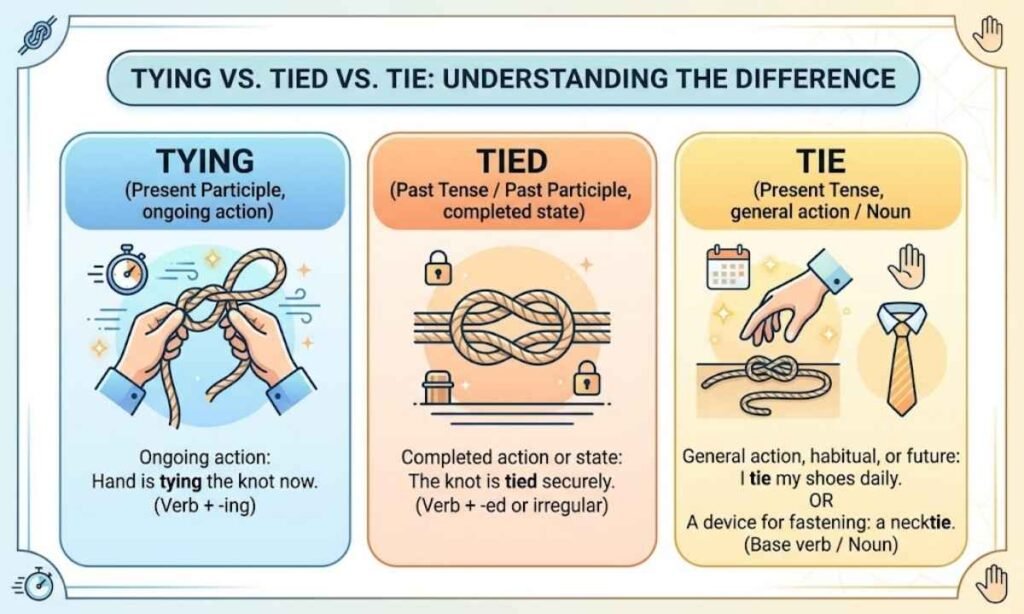
Tie, Ties, Tied, and Tying Explained
| Form | Word | Example |
| Base form | tie | I tie my shoes daily. |
| Third person | ties | She ties her scarf. |
| Past tense | tied | He tied the rope. |
| Present participle | tying | They are tying a bow. |
When to Use Tying and When to Use Tied
Use tying for actions in progress and tied for finished ones. “I am tying it now” and “I tied it yesterday” show the difference clearly.
Tying in Common Phrases and Idioms
• Tying the knot means getting married.
• Tying up loose ends means finishing small tasks.
• Tying one on is a casual phrase for heavy drinking.
• Tying someone down means limiting their freedom or time.
Each phrase keeps the same spelling, so tieing never appears in correct writing. Whether the meaning is literal or figurative, the ing form always uses tying. You will see it in news headlines, sports reports, and everyday speech, and the spelling never changes.
Tying, Lying, and Dying: Similar Spelling Rules
Tie → Tying
Tie loses its ie and gains ying, which gives tying.
Lie → Lying
Lie follows the same rule and becomes lying.
Die → Dying
Die becomes dying. One caution: dye, meaning to color fabric, becomes dyeing, which keeps its e so it stays different from dying.
How to Remember the Correct Spelling of Tying
A Simple Spelling Trick
Say the words together: tying, lying, dying. If you would never write lieing or dieing, do not write tieing.
Common Mistakes to Avoid
• Keeping the e when adding ing.
• Mixing up tied and tying in tense.
• Treating a rare variant as the standard form.
Compound words cause similar doubts. If you ever wonder whether to write one word or two, our guide on high school or highschool shows how to decide.
Other Spelling Mix Ups Writers Search For
• Not sure whether a term is real? Read kinesthesiology vs. kinesiology for a clear answer.
• Check whether a word ends in ie before adding ing.
• Confirm unusual spellings in a current dictionary.
Quick Proofreading Checklist
• Search for tieing, lieing, and dieing.
• Replace each with tying, lying, or dying.
• Check that the tense matches the sentence.
• Keep dyeing only for color work.
Why Spelling Matters in Professional Writing
Small slips can weaken trust in a proposal, a resume, or a published article. Readers often sense something is off even when they cannot name the error. Correct spelling keeps your message clear and your credibility intact. It also saves editors time, which matters when you submit work to a teacher, a client, or a publisher. Tying is a small word, but getting it right shows care.
Frequently Asked Questions
How Do You Spell Tying?
Tying is spelled t y i n g, from the verb tie.
Is Tieing a Real Word?
It appears only as a rare variant in some dictionaries. Standard writing uses tying.
Is Tying Correct in British and American English?
Yes. Both varieties use tying in the same way.
What Is the Past Tense of Tie?
The past tense is tied, and the past participle is also tied.
Is It Tying the Knot or Tieing the Knot?
It is tying the knot. Tieing the knot is a misspelling.
Is Tying a Gerund?
It can be. In “Tying shoes is easy,” tying acts as a noun.
Why Is Lying Not Spelled Lieing?
Lie follows the same rule as tie, changing ie to y before ing.
Conclusion
Tying is the correct spelling. The verb tie ends in ie, so it changes to y before ing, just like lie becomes lying and die becomes dying. Tieing breaks that rule and should be avoided. Remember the trio tying, lying, dying, and you will spell it correctly every time.

5 thoughts on “Tying or Tieing: Which Spelling Is Correct?”