

Kinesiology is the standard term for the scientific study of human movement. Kinesthesiology is a rare term that most dictionaries and universities do not use.
Quick answer: use kinesiology for the academic field, kinesthesia for the sense of movement, and kinesthetic as the adjective.
Kinesthesiology vs Kinesiology at a Glance
The Short Answer
Write kinesiology when you mean the study of body movement. Kinesthesiology is not the accepted name of the field.
Which Term Is Standard Today?
Kinesiology is standard in universities, research journals, healthcare, and fitness education. It is the term you will see in degree names and job titles.
Quick Comparison of the Two Terms
| Feature | Kinesiology | Kinesthesiology |
| Meaning | Study of human movement | Rare term linked to movement |
| Standard term | Yes | No |
| Academic use | Common | Very limited |
| Degree name | Widely used | Not used |
| Best choice for writing | Yes | No |
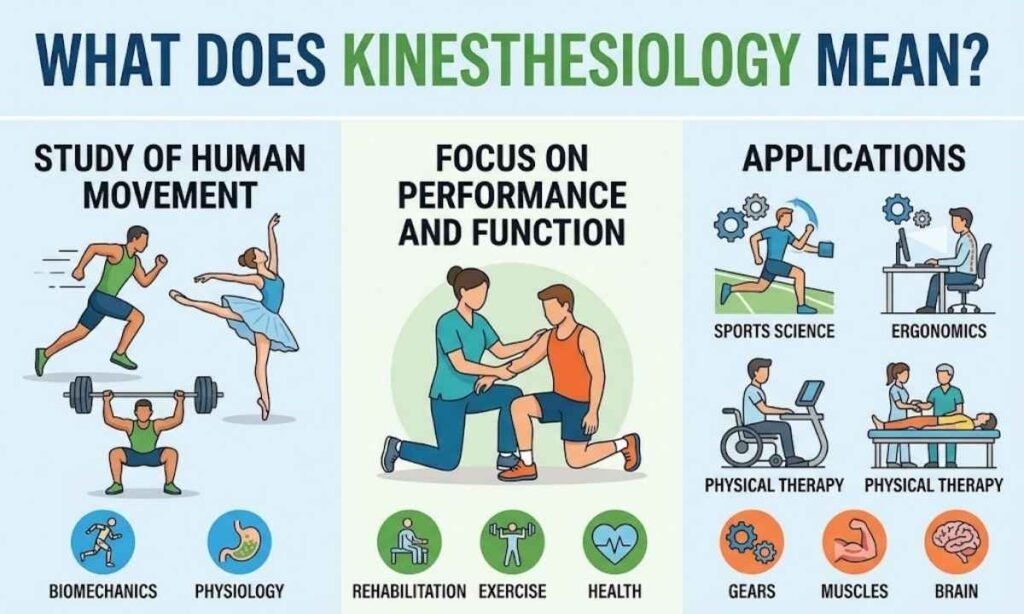
What Does Kinesiology Mean?
Kinesiology Definition
Kinesiology is the scientific study of body movement. The word comes from the Greek kinesis, meaning movement, combined with the ending for a field of study.
What Kinesiology Studies
It looks at how the body moves, why it moves that way, and how movement affects health and performance. The field draws on anatomy, physiology, mechanics, and psychology.
Kinesiology in Sports, Fitness, and Healthcare
In sports, kinesiology supports training and injury prevention. In fitness, it shapes exercise programming. In healthcare, it informs rehabilitation and physical activity guidance.
What Is a Kinesiology Degree?
A kinesiology degree is a college program focused on human movement and physical activity. Students usually take courses in anatomy, exercise science, biomechanics, and motor behavior.
What Does Kinesthesiology Mean?
Kinesthesiology Definition
Kinesthesiology is a rare term that people sometimes use when they mean the study of movement. It is not the established name of any recognized academic field.
Is Kinesthesiology a Real Word?
It appears occasionally in informal writing, but it is not a standard dictionary term. Most readers will assume the writer meant kinesiology.
Why Kinesthesiology Is Rarely Used
Universities, professional bodies, and publishers all use kinesiology. With no institutional support, the longer form never took hold.
How Kinesthesiology Differs From the Standard Term
The difference is recognition, not meaning. Kinesiology is accepted and widely understood, while kinesthesiology looks like a blend of kinesiology and kinesthesia.
Is Kinesthesiology or Kinesiology Correct?
Why Kinesiology Is the Preferred Term
It is the term used in dictionaries, degree programs, research, and professional organizations. Choosing it keeps your writing clear and credible.
Is Kinesthesiology a Misspelling?
In most contexts it works as an error rather than a spelling variant. It is better described as a nonstandard or rare term than a respected alternative.
Can Kinesthesiology Ever Be Used Correctly?
Only in narrow cases, such as quoting a source that uses it or discussing the term itself. Even then, you should explain that kinesiology is the standard form.
Which Word Should You Use in Academic Writing?
Use kinesiology. It is the accepted term for the field in papers, applications, and coursework.
Kinesiology vs Kinesthesia: Why They Get Confused
What Is Kinesthesia?
Kinesthesia is the sense of body position and movement. It lets you know where your limbs are without looking at them.
How Kinesthesia Relates to Body Movement
Your nerves and muscles send signals that help the brain track motion. This sense supports balance, coordination, and skilled movement.
Kinesiology vs Kinesthesia in Simple Terms
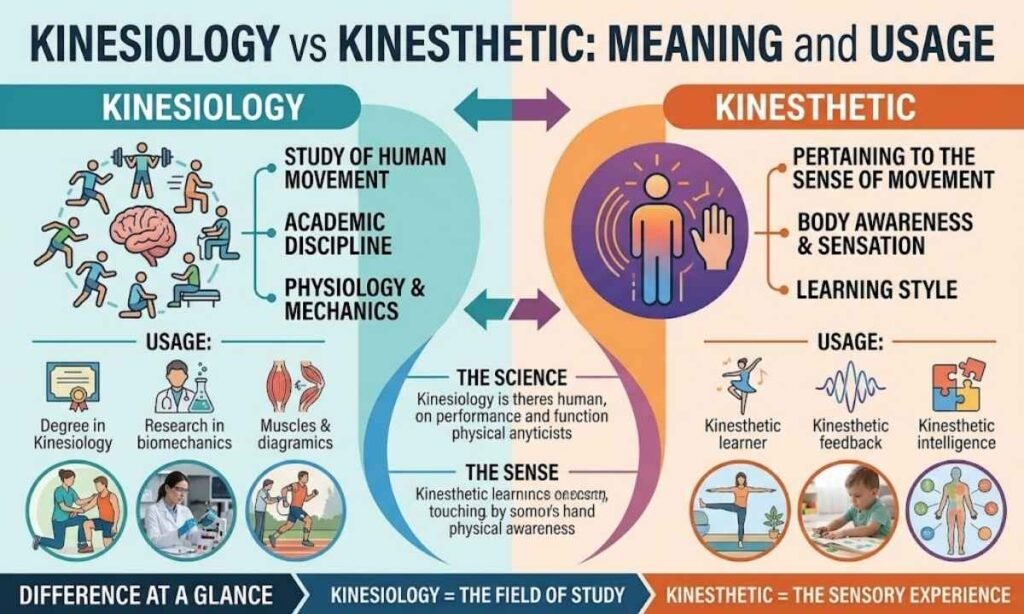
Kinesiology is a field of study. Kinesthesia is a sense that your body has.
Why Kinesthesia Can Lead to “Kinesthesiology”
The two words look alike and both involve movement. Writers often blend them, which produces kinesthesiology.
Kinesiology vs Kinesthetic: Meaning and Usage
What Does Kinesthetic Mean?
Kinesthetic is an adjective that describes anything related to the sense of movement. It is common in phrases such as kinesthetic awareness and kinesthetic learning.
Kinesiology and Kinesthetic Are Not Interchangeable
One names a field of study and the other describes a quality or sense. Swapping them changes the meaning of a sentence.
Kinesthetic Examples in Everyday Language
A dancer shows strong kinesthetic awareness. A kinesthetic learner understands ideas best through movement and touch.
Kinesthesiology vs Kinesiology: Key Differences
| Area | Kinesiology | Kinesthesiology |
| Meaning and definition | Study of human movement | Unclear or informal meaning |
| Scientific and academic status | Recognized field | Not recognized |
| Common contexts | Colleges, clinics, sports | Occasional informal use |
| Professional usage | Standard | Avoided |
| Modern usage and recognition | Widely recognized | Rarely recognized |
Meaning and Definition
Kinesiology has a clear definition tied to human movement. Kinesthesiology has no firm definition in standard references.
Scientific and Academic Status
Kinesiology is an established discipline with departments, journals, and degrees. Kinesthesiology has none of these.
Common Contexts
Kinesiology appears in education, rehabilitation, athletics, and research. Kinesthesiology appears rarely and mostly by mistake.
Professional Usage
Professionals use kinesiology in titles, credentials, and publications. Using the nonstandard form can look careless.
Modern Usage and Recognition
Readers recognize kinesiology immediately. Kinesthesiology often leads to confusion or a quiet correction.
What Does Kinesiology Study?
Human Movement and Body Mechanics
The field examines how muscles, bones, and joints work together to produce motion.
Anatomy and Physiology
Kinesiology relies on the structure of the body and how its systems function during activity.
Biomechanics
Biomechanics applies mechanical principles to movement. It explains forces, posture, and efficiency in walking, running, and lifting.
Exercise Physiology
This area studies how the body responds to exercise, including the heart, lungs, and muscles.
Motor Control and Motor Learning
Researchers study how the nervous system controls movement and how people learn new skills.
Sports and Physical Activity
Kinesiology also covers performance, training methods, and the role of physical activity in public health.
Kinesiology Examples in Real Sentences
Kinesiology in Academic Writing
The study draws on kinesiology to explain how posture affects balance in older adults.
Kinesiology in Healthcare and Rehabilitation
The therapist used principles from kinesiology to design a safe recovery plan after knee surgery.
Kinesiology in Sports and Fitness
The coach applied kinesiology research to improve the team’s sprint technique.
Common Correct Usage Examples
She is majoring in kinesiology. The kinesiology department offers a course in motor learning.
Kinesthesiology Examples and Common Mistakes
Why “I Study Kinesthesiology” May Sound Unusual
Most listeners will not recognize the term. They will probably assume you meant kinesiology and may question your familiarity with the field.
When Readers May Interpret Kinesthesiology Differently
Some readers may link it to kinesthesia and think it concerns the sense of movement. Others may treat it as a typo.
Better Alternatives for Academic and Professional Writing
Write kinesiology for the field. If you mean the sensory side, write kinesthesia or kinesthetic awareness instead.
Kinesiology, Kinesthesia, and Kinesthetic Compared
| Term | Meaning | Typical Use |
| Kinesiology | Study of human movement | Academic and scientific field |
| Kinesthesia | Sense of bodily movement and position | Sensory and movement discussions |
| Kinesthetic | Related to the sensation of movement | Adjective |
| Kinesthesiology | Rare term associated with movement | Limited and rare usage |
The distinction is important because authoritative dictionary sources define kinesiology as the scientific study of body movement, while the related kinesthesia refers to sensing movement and position.
Kinesiology vs Kinesthesiology in College and Careers
Is Kinesiology a College Major?
Yes. Many colleges and universities offer kinesiology as a major, often alongside exercise science.
What Can You Do With a Kinesiology Degree?
Graduates work in fitness, sports, wellness, research, and education. Many also continue to graduate programs in health professions.
Kinesiology Careers in Fitness and Sports
Common paths include personal training, strength and conditioning, athletic coaching, and sports performance analysis.
Kinesiology and Rehabilitation
A kinesiology background supports roles in rehabilitation settings and is a common step toward physical therapy or occupational therapy programs.
Why the Correct Degree Name Matters on a Resume
Employers and admissions teams search for exact terms. Listing your degree as kinesiology matches how programs and job postings are written.
Common Mistakes With Kinesiology Terms
Adding “Thes” to Kinesiology
The extra letters in kinesthesiology create a form that is not standard. Remove them and write kinesiology.
Confusing Kinesiology With Kinesthesia
One is a field and the other is a sense. Match the word to the meaning you intend.
Using Kinesthetic as a Noun
Kinesthetic is an adjective. Say kinesthetic learner or kinesthetic awareness, not a kinesthetic.
Treating Kinesthesiology and Kinesiology as Exact Synonyms
They are not equal in standing. Kinesiology is accepted, while kinesthesiology is a rare and nonstandard form.
How to Remember Kinesiology vs Kinesthesiology
The Simple Spelling Trick
Kinesiology has no “thes” in the middle. If you can read it as kinesis plus ology, you have the right spelling.
Think “Kinesis” for Movement
Kinesis is the Greek root for movement. Add the ending that means study, and you get kinesiology.
Remember Kinesthesia as the Sense of Movement
Kinesthesia ends like anesthesia and refers to sensation. Think of it as the feeling of motion.
Which Term Should You Use in Professional Writing?
For College Applications
Use kinesiology when naming your intended major or program.
For Research Papers
Use kinesiology for the field and kinesthesia only when discussing the sensory system.
For Resumes and Job Applications
List your degree as kinesiology so that it matches job requirements and applicant tracking searches.
For Healthcare and Fitness Content
Use kinesiology for the discipline and kinesthetic for descriptions of movement awareness or learning styles.
Conclusion
Kinesiology is the standard term for the academic study of human movement. Use kinesthesia for the sense of movement and kinesthetic as the adjective.
Treat kinesthesiology as a rare or limited term. In nearly every case, kinesiology is the word you want.
Frequently Asked Questions
Is kinesiology or kinesthesiology correct?
Kinesiology is correct. Kinesthesiology is a rare nonstandard form.
Is kinesthesiology a real word?
It appears occasionally, but it is not a standard dictionary term.
Is kinesthesiology a misspelling of kinesiology?
In most cases, yes. Writers usually produce it by blending kinesiology with kinesthesia.
What is the difference between kinesthesiology and kinesiology?
Kinesiology is the recognized study of human movement. Kinesthesiology has no established standing.
What does kinesiology study?
It studies human movement, including anatomy, biomechanics, exercise physiology, and motor control.
What does kinesthesia mean?
Kinesthesia is the sense of body position and movement.
Is kinesthetic the same as kinesiology?
No. Kinesthetic is an adjective about movement sensation, while kinesiology is a field of study.
Is kinesiology a medical field?
It is a science of movement with strong ties to healthcare, but it is not a medical specialty on its own.
What can you do with a kinesiology degree?
Graduates work in fitness, sports, rehabilitation support, research, and education, or continue to health programs.
Which term should I use in academic writing?
Use kinesiology for the field and kinesthesia for the sense of movement.




6 thoughts on “Kinesthesiology vs Kinesiology: What’s the Difference?”