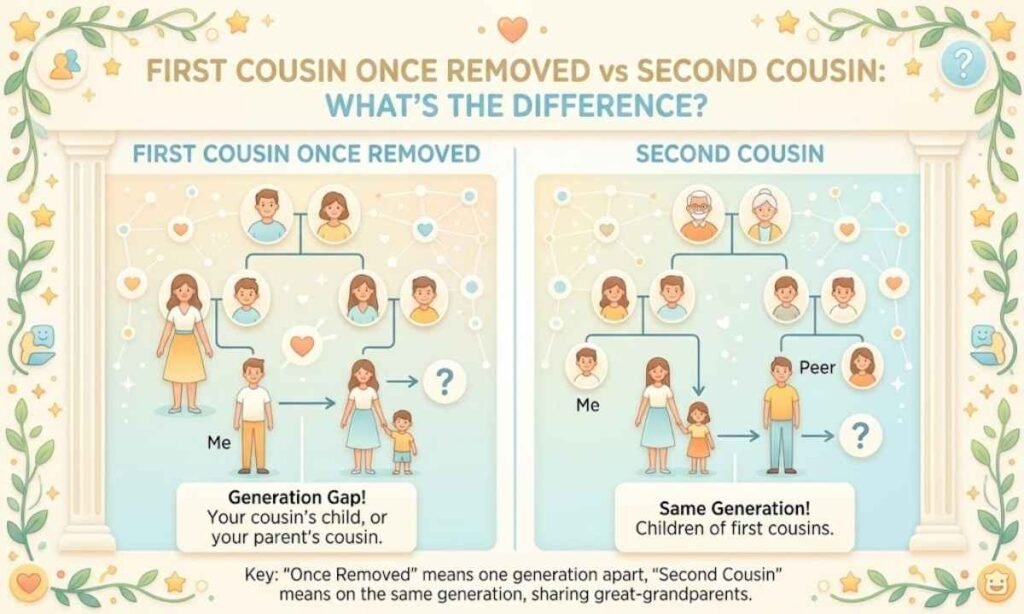
Family terms like “once removed” confuse almost everyone. Here is the short answer: a first cousin once removed is a relative who is one generation apart from your own first-cousin level, while second cousins usually share great-grandparents and belong to the same generation. The trick is to remember that two things are being measured: the cousin degree (the number) and the generation difference (the word “removed”). Below, you will find simple family tree examples, a comparison table, and an easy method to find your exact relationship.
First Cousin Once Removed vs Second Cousin: Key Differences
The main difference is generation. A first cousin once removed sits in a different generation from you, while a second cousin sits in the same one. The table below gives a quick overview.
| Feature | First Cousin Once Removed | Second Cousin |
| Main distinction | One-generation difference | Second-cousin relationship |
| Typical shared ancestors | Grandparents to one person and great-grandparents to the other | Great-grandparents to both |
| Same generation? | No, in the standard relationship | Yes, in the standard relationship |
| Common example | Your first cousin’s child | Your parent’s first cousin’s child |
| Meaning of the term | First-cousin relationship plus one generation | A specific cousin degree |
What Is a First Cousin Once Removed?
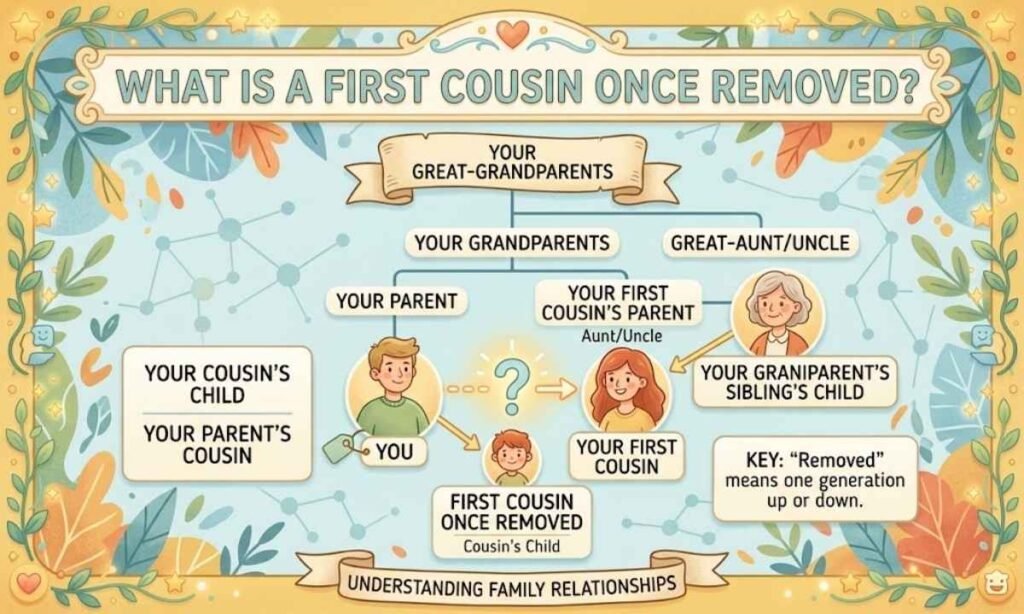
A first cousin once removed is either your first cousin’s child or your parent’s first cousin. You share a set of grandparents with one of them, but the other person is one generation above or below you.
What Is a Second Cousin?
A second cousin is someone who shares great-grandparents with you but not grandparents. You are usually in the same generation, such as two people who grew up as the grandchildren of siblings.
Quick Comparison of Both Relationships
If the person is in your generation and you share great-grandparents, they are a second cousin. If they are one generation up or down from a first-cousin match, they are a first cousin once removed.
What Does First Cousin Once Removed Mean?
The phrase combines two ideas: “first cousin” tells you how close the shared ancestors are, and “once removed” tells you the generations are off by one.
Your First Cousin’s Child
If your aunt or uncle has a child, that child is your first cousin. When that first cousin has a child, that child is your first cousin once removed. You share grandparents with the parent, but the child is one step further down.
Your Parent’s First Cousin
The relationship works in reverse too. Your parent’s first cousin is your first cousin once removed, because they are in your parent’s generation while sharing the same family line.
Why “Once Removed” Means One Generation Apart
The word “removed” counts how many generations separate two people. Once removed means one generation apart, twice removed means two, and so on. It does not say anything about age or how close you feel.
What Does Second Cousin Mean?
Second cousins are in the same generation and share great-grandparents. They are one step further away than first cousins in terms of the family tree.
How Second Cousins Share Great-Grandparents
Imagine two siblings who each have children, grandchildren, and great-grandchildren. The great-grandchildren of those siblings are second cousins to each other, because their shared ancestors are two generations above their parents.
Why Your Parent’s Cousin’s Child Is Your Second Cousin
Your parent and their first cousin share grandparents. Their children, in turn, share those same people as great-grandparents. That makes your parent’s first cousin’s child your second cousin.
How Second Cousins Fit Into a Family Tree
On a family tree, second cousins appear on the same horizontal level, with two branches that split at the great-grandparent line. Keeping your tree neat helps; some people add a labeling system with colors for each branch, which makes it easier to read.
First Cousin Once Removed vs Second Cousin Family Tree
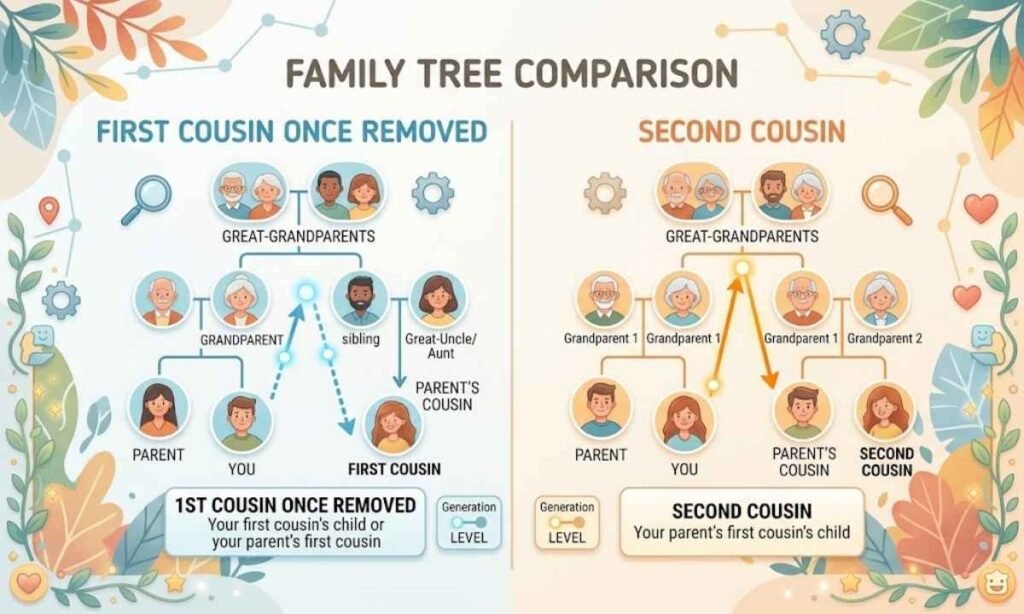
Let us use one simple family to make this concrete. Grandpa Joe and Grandma Rose have two children, Dana and Ben. Dana’s child is Alex, and Ben’s child is Sam. Sam has a daughter named Mia.
A Simple Example of a First Cousin Once Removed
Alex and Sam are first cousins because they share grandparents Joe and Rose. Sam’s daughter Mia is Alex’s first cousin once removed, since she is one generation below Alex’s own level.
A Simple Example of Two Second Cousins
Now suppose Joe has a sibling whose child is Lee, and Lee has a son named Noah. Dana and Lee are first cousins, so Lee is Alex’s first cousin once removed. Noah, who is in Alex’s generation, is Alex’s second cousin because they share Joe’s parents as great-grandparents.
How to Identify Your Relationship Step by Step
- Find the most recent common ancestor. This is the closest ancestor, or couple, you both descend from.
- Count the generations from each person up to that ancestor. Write down both numbers.
- Use the smaller number to find the degree and the difference to find “removed.” Subtract 1 from the smaller number to get the cousin degree, and the gap between the two numbers is how many times removed.
For Alex and Mia, the numbers are 2 and 3. The smaller number minus one gives first cousin, and the gap of one gives once removed. For Alex and Noah, the numbers are 3 and 3, so they are second cousins with no removal. When you are totaling the generations, double-check each count before you name the relationship.
Is a First Cousin Once Removed Closer Than a Second Cousin?
Both relationships are fairly close in the larger family tree, and on average they share a similar amount of DNA. Genealogy sites commonly report about the same expected shared DNA for both, although real results can vary from person to person.
Comparing Shared Ancestors
A first cousin once removed shares grandparents with one person and great-grandparents with the other. Second cousins share great-grandparents with each other. In both cases, the shared ancestors are a single couple from about the same distance up the tree.
Does Age Determine Your Cousin Relationship?
No. The relationship is based on generations, not birthdays. A first cousin once removed can be older than you, and a second cousin can be much younger.
Why “Once Removed” Does Not Mean Less Related
“Removed” only counts the generation gap. It does not mean the person is a weaker or more distant relative. A good way to keep it clear is to see the terms as labels. People who like clear systems often try to optimize their family records the same way, and a simple chart does the job well.
Common Mistakes When Identifying Cousins
A few mix-ups come up again and again in family conversations and genealogy forums.
Calling Your First Cousin’s Child Your Second Cousin
This is the most common mistake. Your first cousin’s child is your first cousin once removed, not your second cousin. Second cousins are in the same generation.
Confusing Cousin Degree With Generation Difference
The number (first, second, third) shows how far back the shared ancestors are, while “removed” shows the generation gap. A second cousin once removed is not the same as a first cousin once removed, because the degree is different.
Assuming Older Relatives Are Always More Distant Cousins
Some people believe that older relatives must be further away from them. In reality, an older relative could be a first cousin once removed or even a closer relative, depending on the family tree. A drier way to say this: the tree decides the term, not the birth year.
Frequently Asked Questions
Is my first cousin’s child my second cousin?
No, your first cousin’s child is your first cousin once removed. Second cousins are in your own generation.
Is my parent’s first cousin my first cousin once removed?
Yes, your parent’s first cousin is your first cousin once removed. They are one generation above you.
Can a first cousin once removed be older than me?
Yes, age does not decide the term. The relationship depends on generations, so older and younger relatives can both qualify.
Do second cousins share the same great-grandparents?
Yes, second cousins share at least one set of great-grandparents. They do not share grandparents.
Is a second cousin once removed the same as a first cousin once removed?
No, they are different relationships. A second cousin once removed is one generation away from a second-cousin match, so the shared ancestors are further back.
What does twice removed mean?
Twice removed means two generations apart. For example, your first cousin’s grandchild is your first cousin twice removed.
Which relationship is more closely related?
Both are about equally close on average, with similar expected shared DNA. Actual amounts differ from person to person. Some families even use a labeller or labeler to tag photo albums by branch, which helps keep track of each relationship.
Conclusion
The difference comes down to two measurements: the cousin number shows how far back the shared ancestors are, and “removed” shows the generation gap. Your first cousin’s child is your first cousin once removed, while your parent’s first cousin’s child is your second cousin. To work out any cousin relationship, find the common ancestor, count the generations for each person, and compare. If you are also tidying up how you write family terms, it can help to review small word choices such as tying or tieing, so your family history stays clear and correct.