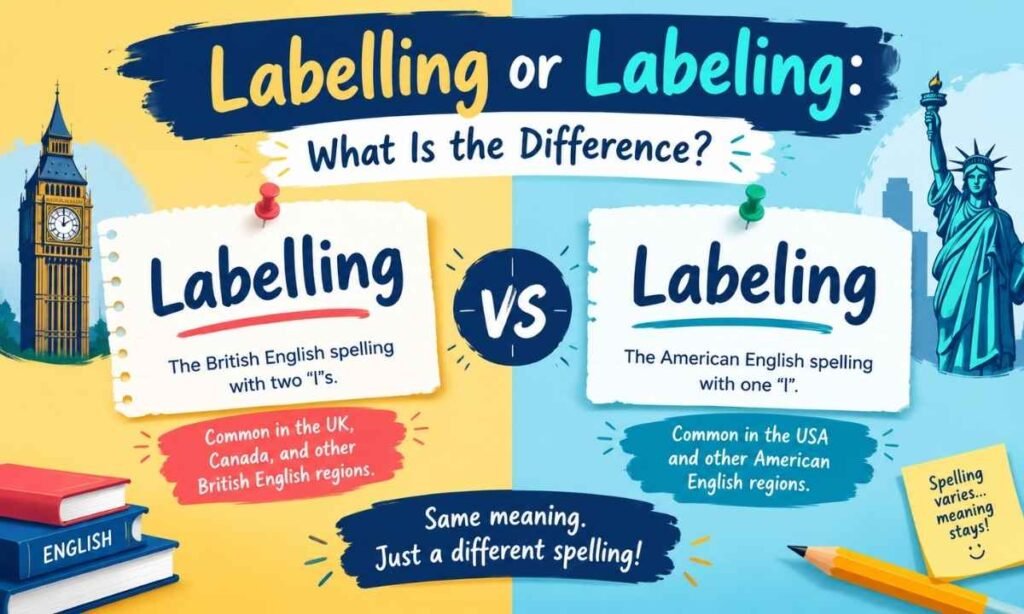
Labelling or labeling spellings are correct, but the right one depends on where your readers live. In American English, labeling is the standard spelling, with one L. In British English, labelling is standard, with two Ls. The meaning is exactly the same.
This guide explains the spelling rule in plain language and compares labeling and labelling in a clear table. You will also see example sentences and related forms such as labeled, labelled, labeler, and labeller, so you can choose the right spelling with confidence.
Labelling or Labeling: Which Spelling Is Correct?
Is Labelling Correct in British English?
Yes. Labelling, with two Ls, is the standard spelling in the UK. It sits alongside other British forms such as labelled and labeller.
Is Labeling Correct in American English?
Yes. Labeling, with one L, is the standard spelling in the United States. It matches American labeled and labeler.
Quick Answer: Labelling vs. Labeling
Use labeling for American readers and labelling for British readers. Neither spelling is a mistake, and both mean the same thing.
What Does Labelling or Labeling Mean?
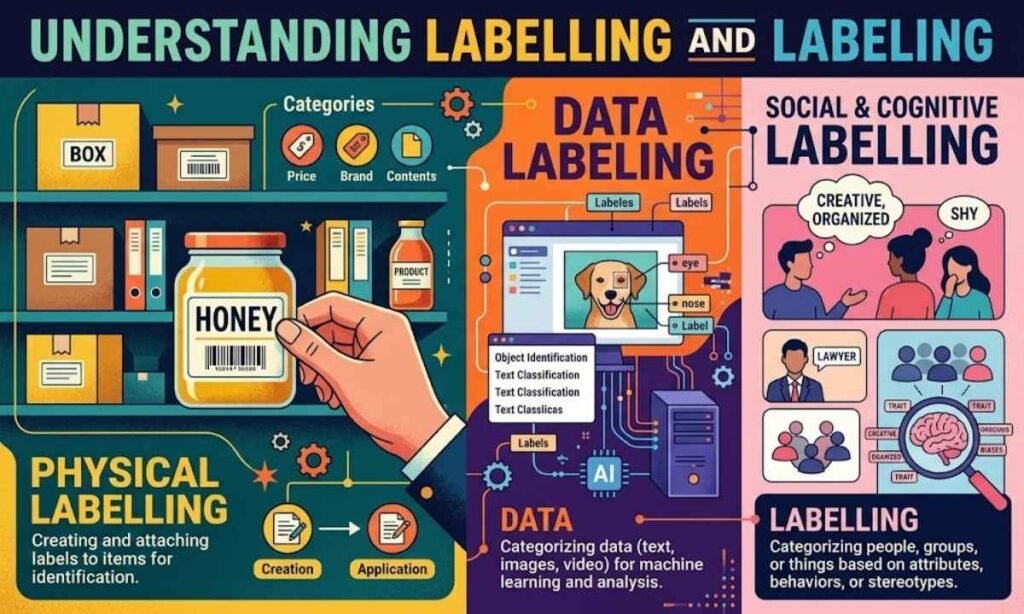
Labeling and labelling come from the word label. They describe the act of attaching a label, the labels themselves, or the process of describing something with a name or tag.
Definition of Labeling
Labeling is the American spelling. It can mean putting labels on objects, the printed information on a product, or the act of giving a person or idea a tag, as in food labeling rules.
Definition of Labelling
Labelling is the British spelling of the same word and carries the same meanings. You will see it in UK food guidance, packaging notes, and school materials.
Examples of Labels in Everyday Life
Labels are everywhere. A nutrition panel on a cereal box, a name tag at a meeting, and a warning sticker on a bottle are all labels. Even texting shortcuts act like labels for common phrases, such as WYD for a quick check in or GC for a group chat.
Labelling vs. Labeling: Key Differences
American English vs. British English
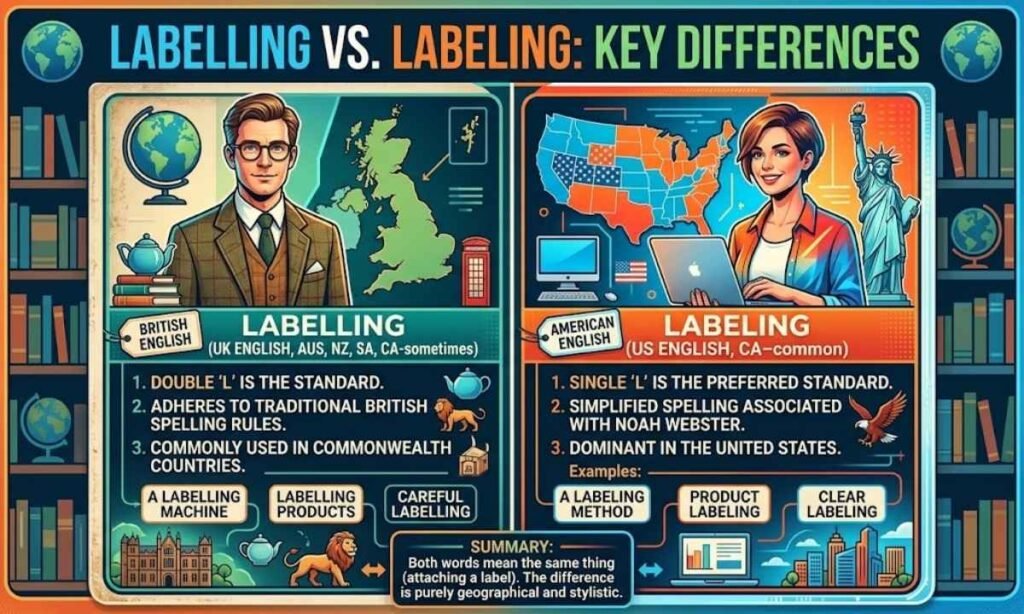
The main difference is regional. American English uses one L before the ending ing, while British English uses two.
Difference in Spelling, Meaning, and Pronunciation
Only the spelling changes. The meaning stays the same, and both words are pronounced LAY buh ling.
Labelling vs. Labeling Comparison Table
| Feature | Labeling | Labelling | Notes |
| Spelling | One L | Two Ls | Same base word, label |
| Region | United States | United Kingdom | Other regions vary |
| Meaning | Applying or describing with labels | Applying or describing with labels | No difference |
| Pronunciation | LAY buh ling | LAY buh ling | Identical |
| Example | Food labeling is strict. | Food labelling is strict. | Match your audience |
Why Does British English Use Labelling With Two Ls?
The British English Consonant Doubling Convention
British English usually doubles a final L when a suffix like ed, ing, or er is added to a verb. That is why label becomes labelled and labelling, and travel becomes travelled and travelling.
Why American English Uses Labeling
American English simplified this habit. When the stress is not on the last syllable, American spelling keeps a single L, which gives labeled and labeling.
How the Rule Applies to Similar Words
This is a general tendency, not a rule for every word that ends in L. When the stress falls on the last syllable, as in control or compel, both varieties double the consonant. A few words, such as fulfill and fulfil, follow separate regional habits, so it is wise to check a dictionary when you are unsure.
Labelling or Labeling in Example Sentences
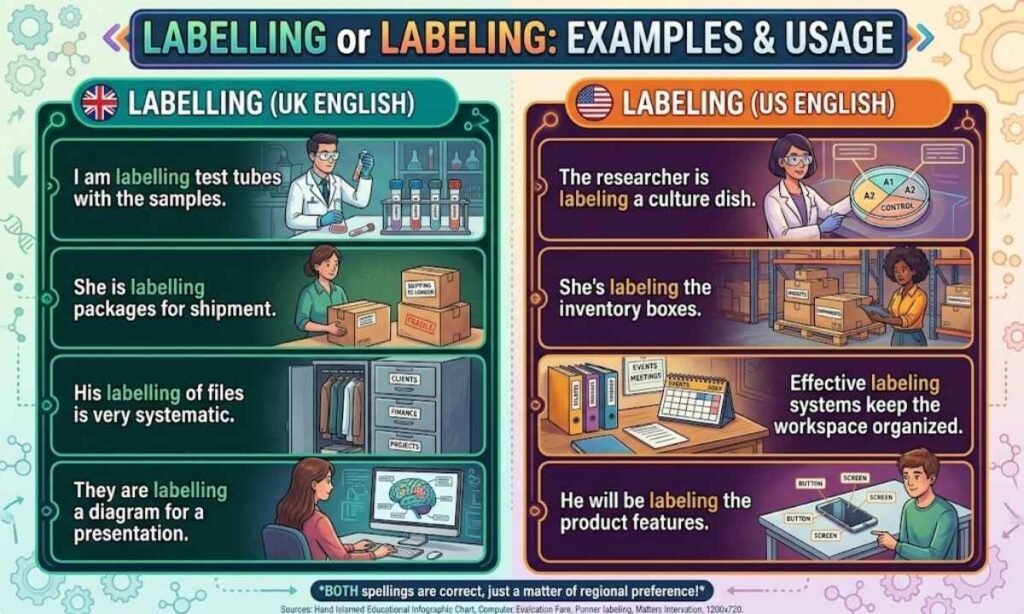
Examples of Labeling in American English
• The labeling on the cereal box lists every ingredient.
• Our team is labeling photos for a new app.
• Clear labeling helps shoppers compare products quickly.
Examples of Labelling in British English
• The labelling on the sandwich shows the allergens.
• She is labelling the storage boxes before the move.
• New labelling rules start in the spring.
Examples in Business, Education, and Product Packaging
In business, accurate labeling protects customers and brands. In schools, labeling diagrams helps students learn. In packaging, labeling must be clear and easy to read. Online communities also label content with short tags, such as OSNS and ASF, to signal tone quickly. British writers would simply use labelling in the same sentences.
Using Labeling as a Verb and a Noun
As a verb form, labeling describes an action in progress, as in “They are labeling the jars.” As a noun, it names the process or the information itself, as in “The labeling is clear.” British English follows the same grammar with two Ls.
Labeled or Labelled: Which Spelling Is Correct?
When to Use Labeled in American English
Use labeled as the past tense and adjective in American English. For example, “The box was labeled fragile.”
When to Use Labelled in British English
Use labelled in British English, as in “The box was labelled fragile.” The same pattern applies in Australia and New Zealand.
Labeled vs. Labelled Example Sentences
• Every folder was labeled by date. (American)
• Every folder was labelled by date. (British)
• The labeled shelves made the pantry easy to use. (American)
• The labelled shelves made the pantry easy to use. (British)
Labeler or Labeller: Which Form Should You Use?
American English: Labeler
Labeler, with one L, is the American spelling for a person or machine that applies labels.
British English: Labeller
Labeller, with two Ls, is the British spelling of the same word.
Examples of Labeler and Labeller in Context
• The label on the packing line works quickly. (American)
• The labeller on the packing line works quickly. (British)
Labelling or Labeling in the US, UK, Australia, and Canada
| Region | Usual spelling | Note |
| United States | Labeling | Standard in American English |
| United Kingdom | Labelling | Standard in British English |
| Australia | Labelling | Generally follows British spelling |
| New Zealand | Labelling | Generally follows British spelling |
| Canada | Varies | Depends on the writer and publication style |
Preferred Spelling in the United States
American dictionaries and style guides prefer labeling, labeled, and labeler.
Preferred Spelling in the United Kingdom
British publications use labelling, labelled, and labeller.
Labelling in Australian and New Zealand English
Australian and New Zealand English generally follow British conventions, so labelling and labelled are the usual forms.
Spelling Preferences in Canadian English
Canadian spelling can vary by word and publication style. Many Canadian writers use labelling and labelled, but American forms also appear, so follow the style guide of your outlet.
Common Mistakes to Avoid When Using Labelling or Labeling
Assuming One Spelling Is Always Wrong
Labeling and labelling are both correct. Calling one of them an error only because it looks unfamiliar is a common slip.
Mixing American and British Spellings
Writing labeling in one paragraph and labelled in another makes text look careless. Pick one variety and keep to it for every related word.
Confusing Labeling With the Incorrect Spelling “Labling”
Labling is not a correct spelling in any variety of English. The word keeps the E, giving labeling or labelling.
Choosing a Spelling That Does Not Match Your Audience
Think about who will read your work. Casual slang like FEIN or ALR suits a relaxed chat, while a US business report needs labeling and labeled, and a UK report needs labelling and labelled.
Similar American and British Spelling Differences
Many verbs that end in L follow the same pattern. This table shows a few of them.
| Base word | American spelling | British spelling | Example |
| Travel | Traveling | Travelling | She is traveling or travelling today. |
| Model | Modeling | Modelling | He is modeling or modelling it. |
| Cancel | Canceled | Cancelled | The trip was canceled or cancelled. |
| Signal | Signaling | Signalling | The light is signaling or signalling. |
Traveling or Travelling
Traveling is American, and travelling is British.
Modeling or Modelling
Modeling is American, and modelling is British.
Canceled or Cancelled
Canceled is the usual American form, though cancelled also appears in the US. Cancelled is standard in British English.
Signaling or Signalling
Signaling is American, and signalling is British.
Frequently Asked Questions
Is it labelling or labeling?
Labelling or labeling are correct. Labeling is the US spelling, and labelling is the British spelling.
Is labelling spelled with one L or two?
Labelling uses two Ls in the middle, and labeling uses one. The two Ls version is British.
Is labeling American or British English?
Labeling is American English. British English uses labelling.
Is labelling grammatically correct?
Yes. Labelling is fully correct in British English and in regions that follow British spelling.
Why do British people spell labelling with two Ls?
British English usually doubles a final L before endings like ing and ed. It is a long standing spelling convention.
Do Canada and Australia use labelling or labeling?
Australia generally uses labelling. Canada varies by writer and publication style.
What is the past tense of label?
The past tense is labeled in American English and labelled in British English.
Should I use labeling in US academic writing?
Yes. Use labeling, labeled, and labeler to match American style guides.
Conclusion
Labeling is standard in American English, while labelling is standard in British English. Both spellings mean the same thing, so neither one is wrong.
Use labeling for US focused content and labelling for British English. Whichever you choose, keep the related words consistent, including labeled, labelled, labeler, and labeller, from the first line to the last.


5 thoughts on “Labelling or Labeling: What Is the Difference?”