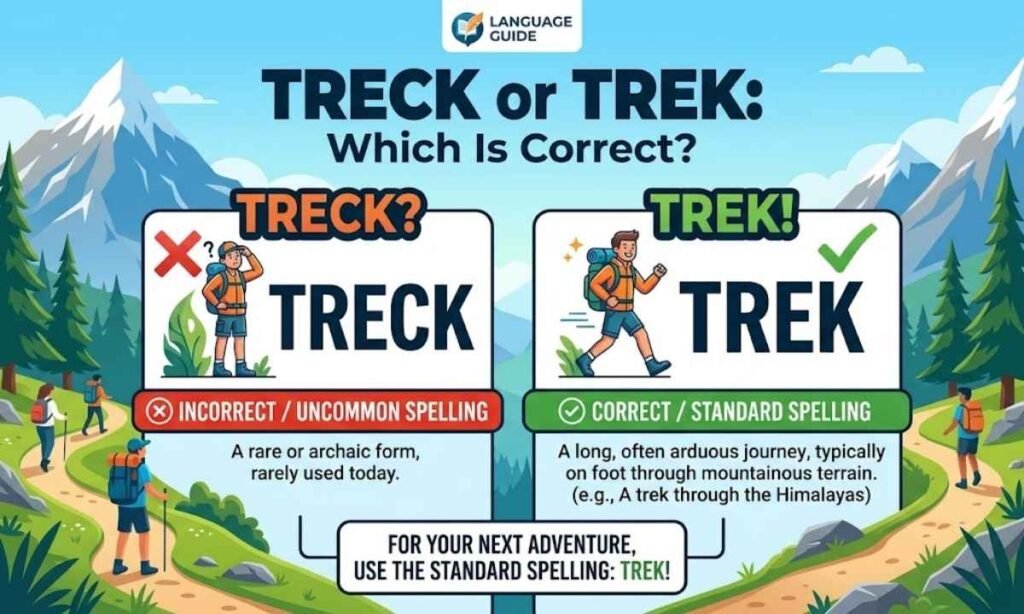
If you have ever typed “treck” and wondered whether it looks right, you are not alone. The correct spelling is trek, a word for a long or difficult journey, often made on foot. Treck is generally a misspelling when you mean a journey. In this guide, you will learn what trek means, how its verb forms work, how to pronounce it, and easy ways to remember the spelling.
Treck or Trek: Which Spelling Is Correct?
Trek is the standard spelling in American English. The table below shows the correct forms and the common mistakes at a glance.
| Word | Correct? | Meaning or Usage |
| Trek | Yes | A long or difficult journey |
| Treck | Generally incorrect for this meaning | Common misspelling of trek |
| Trekking | Yes | The activity of making a trek |
| Trekked | Yes | Past tense of trek |
| Trecking | Incorrect for the intended meaning | Misspelling of trekking |
| Trecked | Incorrect for the intended meaning | Misspelling of trekked |
Why Trek Is the Correct Spelling
English borrowed the word from Afrikaans and Dutch, where it relates to pulling or traveling, and it spread through accounts of long wagon journeys in southern Africa. Dictionaries such as Merriam-Webster and Cambridge list trek, with no “c,” as the proper spelling, so it is the safe choice for any kind of writing.
Is Treck Ever a Correct Word?
Not as a spelling of the journey word. You may sometimes see Treck as a surname or brand name, and those cases are fine because proper names follow their own spelling. For ordinary writing, however, treck is simply a typo for trek.
Quick Comparison of Treck and Trek
Trek is the word you want for a journey, a hike, or a long effort. Treck has no separate meaning in everyday English. If you are writing about travel, hiking, or a tiring walk, use trek every time.
What Does Trek Mean?
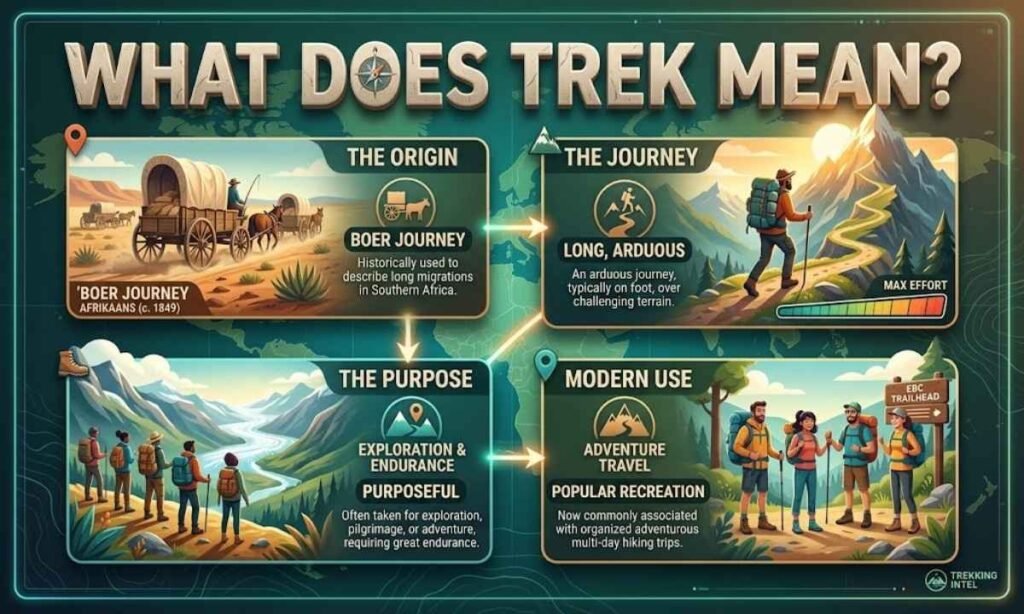
Trek means a long, slow, or difficult journey, usually one that takes effort. It works as both a noun and a verb.
Trek as a Noun
As a noun, a trek is the journey itself. For example, “The trek to the mountain village took three days.” It can also describe a long walk to somewhere that feels far away, even in a casual way.
Trek as a Verb
As a verb, to trek means to travel a long way, especially on foot and with some difficulty. For example, “They trekked through the forest to reach the lake.”
When to Use Trek in Everyday English
Use trek for hiking, long travel, or any trip that feels tiring. People also use it jokingly, as in “It’s a trek to the supermarket from here.” It is a flexible word that fits both serious and casual writing.
Why Do People Confuse Treck and Trek?
The mix-up is very common, and there are clear reasons behind it.
How English Spelling Patterns Cause Confusion
Many short English words end in “ck,” such as check, deck, neck, and wreck. Because trek rhymes with these words, writers often assume it should end the same way. English spelling does not always follow the sound.
Why Trek Is Spelled Without a C
Trek keeps the spelling of the Afrikaans and Dutch word it came from, which has a plain “k.” English did not change it to match the “ck” pattern, so it stayed as trek. Just as people debate optimize or optimise, spelling often follows a word’s history, not its sound.
Easy Ways to Remember the Correct Spelling
Try this trick: trek has only four letters, and the “k” does all the work. You can also link it with the word “trekker” or with the film and TV name Star Trek, which is spelled the same way. If you picture the title, you will not add an extra “c.”
Trek, Trekking, or Trekked: Which Forms Are Correct?
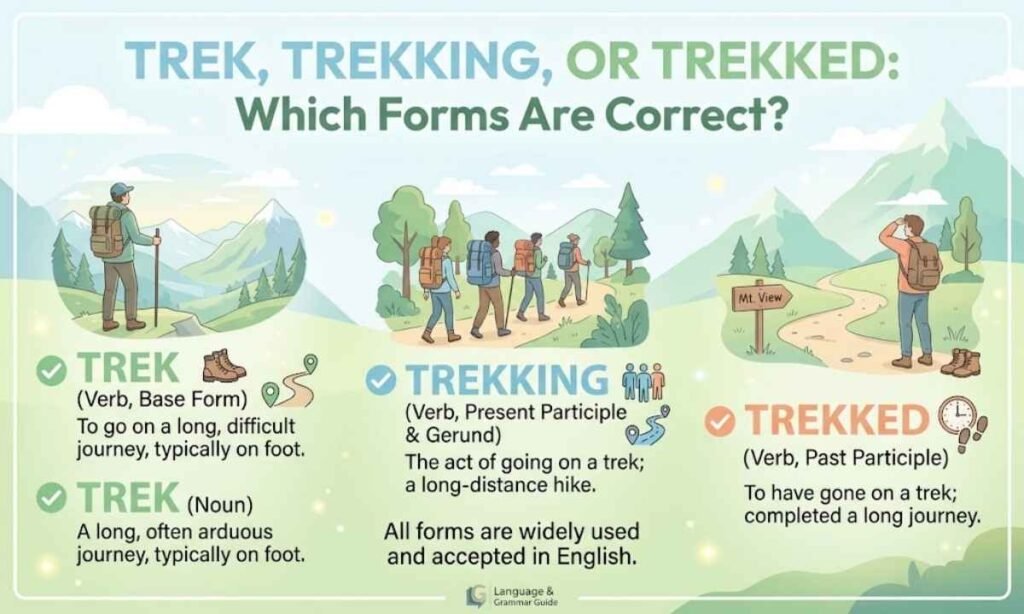
The base word is trek, but the forms with endings double the final letter. Here is how each one works.
When to Use Trek and Treks
Use trek for the base form and treks for the plural noun or the third-person verb. For example, “She treks every summer,” and “Their treks across Asia were famous.”
Trekking vs. Trecking
Trekking is correct, and trecking is a misspelling. The final “k” is doubled before “-ing” because trek is a short word with one vowel and one final consonant. Doubling rules like this also explain forms such as labelling or labeling, where British and American English handle the final letter differently.
Trekked vs. Trecked
Trekked is the correct past tense, and trecked is wrong. The same doubling rule applies, so you add a second “k” before “-ed,” just as you do with words like totalling or totaling in other spelling debates.
What Is a Trekker?
A trekker is a person who makes a trek, such as a hiker on a long mountain route. Note that it takes two “k”s, and the person-noun is often built the same way as in labeller or labeler.
How to Use Trek in a Sentence
The examples below show how trek works in different settings.
Examples of Trek in Travel and Hiking
- “We planned a five-day trek through the Himalayas.”
- “The group trekked across the desert before sunrise.”
- “Trekking boots should be broken in before a long trip.”
Examples of Trek in Everyday Conversations
- “It’s a real trek from my house to the train station.”
- “I trekked all over town looking for that book.”
- “Don’t make me trek to the other side of the mall.”
Using Trek Figuratively for a Difficult Journey
Trek can also describe a long effort that is not a physical walk. For example, “Finishing her degree while working full-time was a long trek,” or “The project was a slow trek through paperwork.”
How to Pronounce Trek
Trek is a single syllable pronounced “trek.”
Trek Pronunciation in American English
In American English, trek sounds like the first part of “trekking,” with a short “e” as in “bed,” followed by a hard “k.” There is no extra sound for the missing “c.”
Words That Rhyme With Trek
Trek rhymes with check, deck, neck, speck, and wreck. Notice that these rhyming words are often spelled with “ck,” which is exactly why many people mistakenly write treck.
Synonyms for Trek
Several words are close to trek, but each carries a different feeling.
Trek vs. Hike
A hike is usually a walk in nature, often for fun and sometimes short. A trek is longer, harder, and more demanding, and it may last several days.
Trek vs. Journey
Journey is a general word for any trip from one place to another. Trek is more specific and suggests effort, distance, or difficulty.
Trek vs. Expedition
An expedition is an organized trip with a clear goal, such as exploration or research. A trek can be personal and informal, with no special mission.
Frequently Asked Questions
Is it treck or trek?
The correct spelling is trek. Treck is a common misspelling.
Is treck a real English word?
No, treck is not a standard English word. It appears mostly as a typo, a name, or a brand.
Why is trek spelled without a C?
Trek keeps the plain “k” from its Afrikaans and Dutch origin. English never changed it to the “ck” pattern.
Is it trekking or trecking?
The correct form is trekking. Trecking is a misspelling, since the final “k” doubles before “-ing.”
Is it trekked or trecked?
The correct past tense is trekked. Trecked is wrong, because the “k” is doubled before “-ed.”
What does trek mean in simple English?
Trek means a long and difficult journey, usually made on foot. As a verb, it means to make that kind of journey.
Is trek the same as hiking?
Not exactly, because a trek is usually longer and tougher than a hike. Many treks last several days, while hikes are often shorter and easier. Just as drier or dryer sound alike but differ in use, trek and hike overlap but are not identical.
Conclusion
So, treck or trek? Trek is the correct spelling for a long or challenging journey, and treck is simply a common mistake. Remember the correct forms: trek, treks, trekked, and trekking. A quick reminder is to picture Star Trek, and you will never add an extra “c.” If you also wonder about verb endings like tying or tieing, keep checking a dictionary and your writing will stay accurate.